Fly a capsule from entry interface, heat its stagnation point with Sutton–Graves, conduct that heat through tile, adhesive and aluminium skin, and find the thinnest tile that keeps the structure below its limit.
Compute the current case to inspect the temperature at each depth and time. The baseline cards above are a stored reference.
Which tile? Size all three for these conditions
Tile
Density
Thickness
Areal mass
Peak surface
Max use
Surface
Press Compare tiles to size LI-900, LI-2200 and FRCI-12 for the current entry.
Areal mass includes all three layers. The lightest tile that passes its own surface limit is in bold.
Parameter study
Re-size the selected tile at each value while keeping all other inputs and advanced settings fixed. Each point is a new coupled simulation; failed points are reported, not interpolated.
These are fixed reference studies from the Python repository, not a recomputation for the current slider settings. The live browser model is also checked against the published baseline for all three tiles in automated tests.
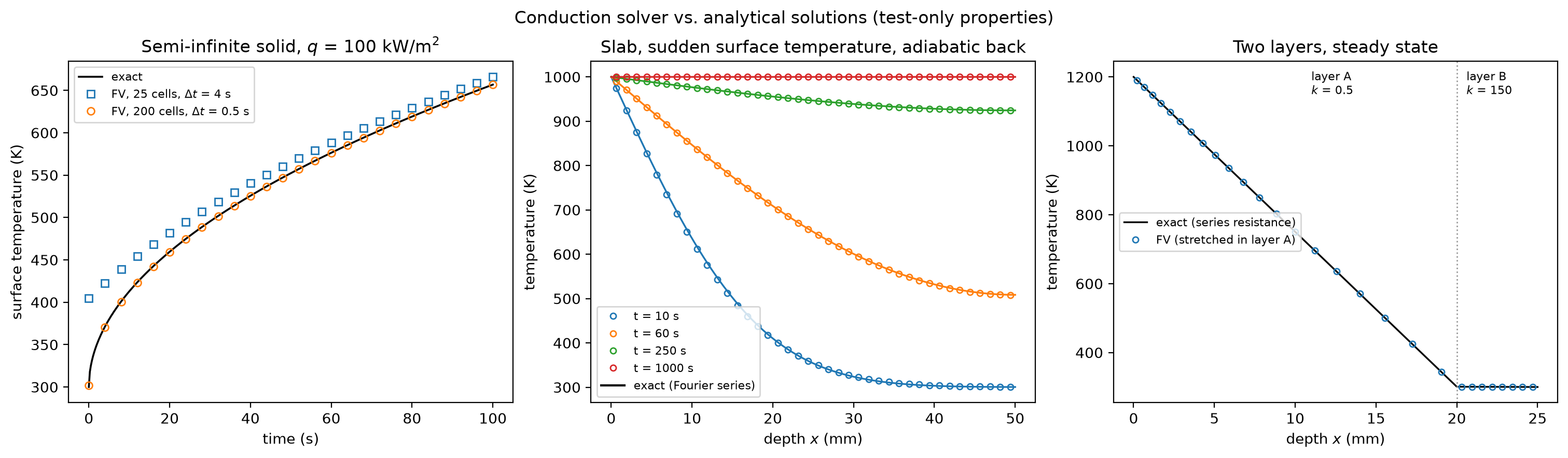
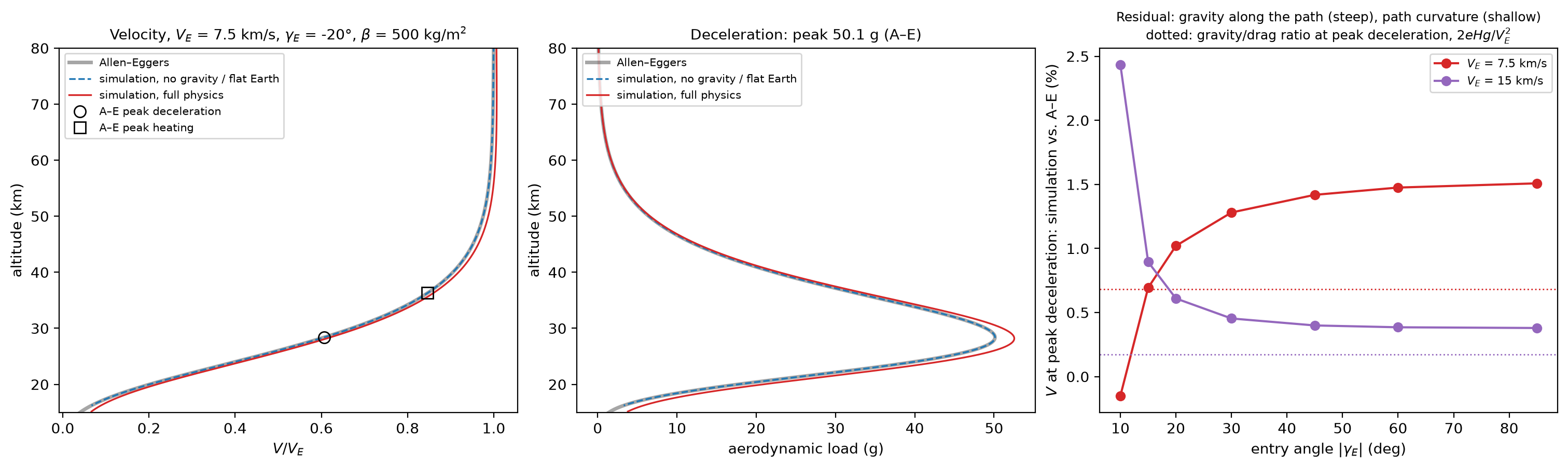
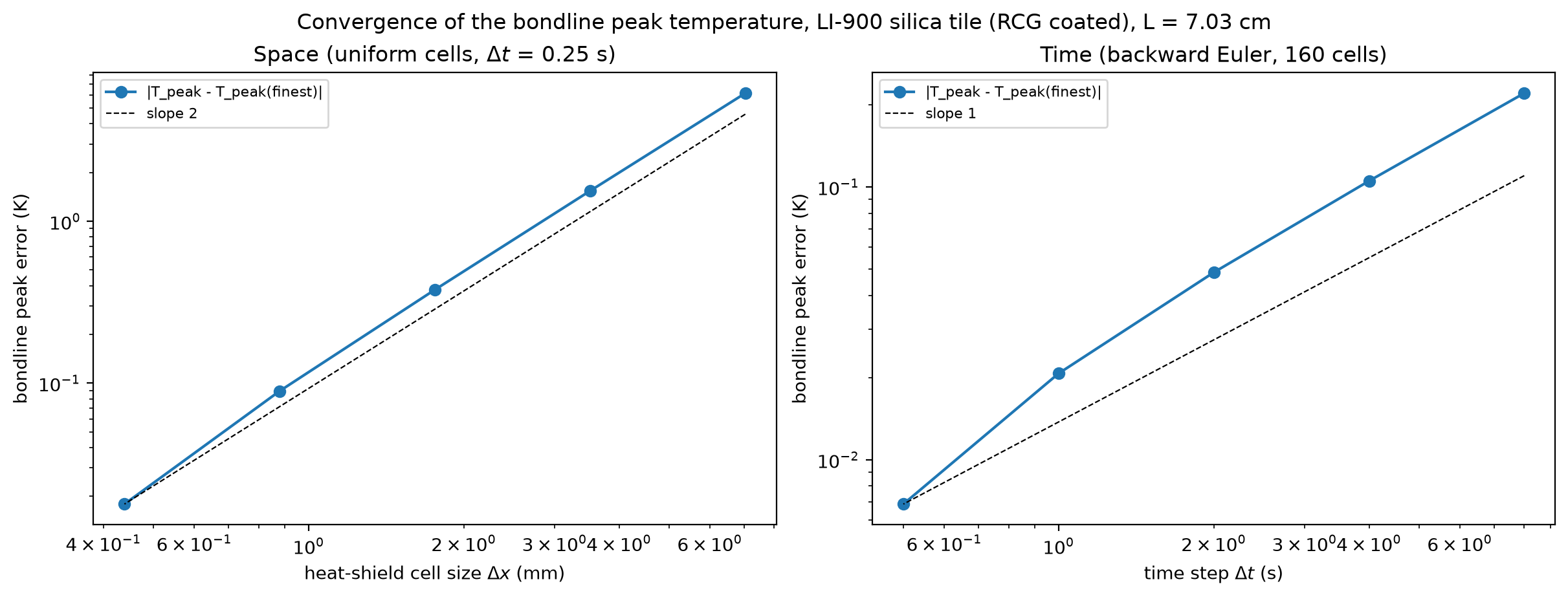
Conduction verification against analytical solutions; see the repo’s conduction and energy tests for tolerances.Allen–Eggers comparison: the analytical reference assumes constant entry angle and neglects gravity; full-physics differences are expected.Baseline refinement study: second order in cell size and first order in time for backward Euler. This supports the default 60-cell stretched grid and 0.5 s step.